Before we began animating, we each created a proof of concept for the scenes that we were doing to see that we were able to animate them. The scene I created a short animation for was the camera panning up from the doll to show it being placed on an operating table with the kids hovering over it. I did this scene to figure out how to work the camera angle and how to animate the doll’s heart beating.
I also did a short lip sync animation of the host to a dialogue audio to see how animating him could look.
Animation process
Clean animation
When animating the cleaned lines for the first scene, I was figuring out how to move the characters within the camera angles they were at and how to have the doll move around. I had the girl twist the doll’s head back and forth and tug it slightly to make the scene more interesting rather than have her just pull the doll’s head straight off.
When cleaning up the lines in the surgery scene, I sought to make the lines go from thinner in the distance to thicker up close. I also had to figure out how to have the camera pan up to reveal the kids hovering over the doll. I initially thought of having the kids enter the frame from the side when the camera pans up. However, I decided to just have the kids already be at the table when the camera goes up. I added details such as the kids wiggling their fingers and the girl slowly lowering her scalpel towards the doll to add to the scene.
Colouring
When colouring the first scene, I added details such as the stripes on the doll’s arms that I had previously neglected to add in the clean animation and the shine on the girl’s glasses. I also animated the scene to have action lines when the doll’s limbs are detached to emphasise the brutality of the children’s actions.
When colouring the surgery scene, I made the background completely black rather than having a coloured background like the others. This was because I felt that using the same patterned background as the other scenes for this scene would’ve made the colours clash too much and distract from the doll. Also, having the scene be dark helps to amplify the ominous atmosphere of the doll undergoing surgery.
Shading
When shading the first scene, I kept it consistent to have the kids and the doll under the same lighting.
When shading the second scene, I added the shading on the characters to follow the lighting they had in the concept art of the surgery scene. I added details such as a shine on the heart to give it texture, as well as shading inside the chest of the doll to give it depth, and further details of the doll’s shadow on the table.
The initial idea we came up with was what if there was an ad for a Frankenstein creature and the creature rebels against its owners. The story then developed into an ad for a Frankenstein-like doll that was alive and would go through brutal playtime with children and it could feel pain inflicted upon it.
The initial mind map we made for the story – the aspects of Frankenstein we focused on were ‘hybrid’ and ‘macabre’Our mood boards on our aesthetic and animation style inspirationsInitial sketches I did of my rough version of the story and storyboards
When developing our story, we each began by writing our own version of the story. We each wrote a rough outline of the plot points of the film and rough storyboards. In my version, the whole film is an ad that introduced the doll as being alive and being tortured by children as part of its play features. In a scene where the children are about to cut up the doll while pretending to do a surgery on it, the doll jumps up and attacks the camera crew, cutting the ad.
When combining our individual story drafts, the final story was changed so that the doll attacked a child watching the ad in real life, rather than during the ad. We then changed the ending to have a child watching the ad be strangled by the doll and the film revealing that the dolls are being recalled due to being dangerous, implying other children have been harmed by the doll as well. Several scenes that made it to the final version include the children taking off the head of the doll and rearranging its limbs, and the children playing surgery with the doll.
Rough storyboard sketches I did of the doll strangling the childOur log line for our plot
Character Development
Doll (Frenzie)
For the design for our doll, we took inspiration from toys such as Pop Mart figurines to get the idea of toys that are marketable to a mass market. We sought to create a doll that had aspects of being marketed to kids but having an ominously evil feeling to it.
Our mood board for the design of our doll – we took inspiration from the rubber hose art style to give it a retro feeling
During the development process, every one of our group members did our own design of how the doll looked with our own art styles and we decided to combine them together to see which features of the doll we liked the most to create the final version. The features we liked in particular were the pointed horn-like pigtails and the long and exaggerated limbs which we felt would allow the doll to move in very expressive ways.
The colour palettes we experimented with for the doll – we decided to go with the bottom right corner green colour palette
After designing the doll, we had a group call session where we all drew the doll together to make sure that we all understood how to draw the doll and keep the style consistent for when we animated which I felt really helped us improve our consistency between our scenes.
Host
For the character of the tv show host advertising the doll, I designed him based off of tv show game hosts from the 1960s. In particular, I wanted to capture the charismatic personality the hosts would have. I wanted to twist their cheerfulness to create a sense of eeriness.
Initial mood board of design inspiration for the host – I took inspiration from characters such as Winston Deavor from The Incredibles 2, King Dice and the Devil from Cuphead, and the Governor from the Gobelins student film Rest in PeaceWhen sketching his design, I sought to give him a creepy expression by having an unnatural smile that was always upturned and stared at the audienceTo design the host, I drew over the heads of actual tv show hosts and combined their features to design the host. I also added features such as having his shoulders and the ends of his hair pointed to create an evil silhouette.
Storyboards
For my scenes, I animated the opening of the ad which shows children playing with the doll in brutal ways and mutilating it. I sought to make use of dynamic camera angles and tried to emphasise the macabre aspect of the story by having the camera focus on the doll’s still expression as its being played with.
Script
Our group member Kim wrote our script with the dialogue in our animatic primarily being the host talking, apart from a couple of lines that for one of the kids. I did the voice acting for the host and while it was initially only for use in the animatic to see how to time the dialogue with the scenes, we ended up using it for the final version as we felt it worked well enough.
Animatic
In our initial version of the animatic, edited by our group member Kim, we combined our storyboards with a few proof of concept clips that our group members had done. Because we needed 15 seconds of proof of concept footage, we decided to split it between us three to each member doing a five second proof of concept for each of their scenes to see how each member’s storyboards could look in the final animatic. We presented this animatic in our first presentation which saw our film successfully greenlit. Some feedback that we received was that we needed to make the scenes of the ad and the scenes showing the kid in real life watching the ad easier to differentiate. We were also told we needed to make the dialogue more clear as we had edited it to sound a little distorted to make it sound like an old tv ad but it was too distorted that it was hard to hear at times.
In the final version, we added changes such as having the logo of the toy company at the beginning to add world building, and we changed the audio of the host to make it less distorted so that we still had the voice sounding like it came from an old tv but it is now more clear to listen to.
Scenes
I drew concept art of several scenes to figure out the colour palette and the lighting of the scenes.
Concept art I made of the host with the dollConcept art I made of the kids playing surgery with the dollConcept art I made of a kid watching the ad on tvConcept art I made of the host introducing the doll
For the scene where the host is introducing the doll, I initially designed the background of the ad as having a darker brown colour palette. However, we were given feedback that the background was too dark and the background design was too ‘adult’. So, I redesigned the background to have a brighter colour palette with a more vibrant design with stars and shapes.
Concept art I made of the background of the ad
Backgrounds
Backgrounds I drew of the scenes during the ad
For the backgrounds, I sought to warp the perspective as much as I could and used the patterns of the backgrounds to help create a surreal sort of feel for the backgrounds.
Concept art I made of the tv the kid is watching at the end of the film
For the background of the tv the kid is watching from, I sought to create an eerie atmosphere by warping the perspective of the wallpaper and the tv, as well as by pushing the shadows and the lighting. I took inspiration from tv’s and wallpapers from the 1960s to have the retro feel of the rest of the ad.
While going through the principles of animation again and analysing examples of how they are implemented in films, we were tasked to take a scene from line test drawings from the film The Prince of Egypt and analyse how the characters were animated. The scene I chose to analyse was of Rameses’s father Pharaoh Seti talking. During my analysis of his movements, I specifically focused on aspects such as how he transitions between different poses and the smaller bits of his body actions that changes with each pose.
For my final film, I wanted to create something that combines elements from all of the different tests that I had done. The idea that I had came up with was to make an animation that depicts anxiety. Because I had gotten feedback to make use of a medium other than animation paper since I had been using it for all of my previous tests, I decided to try creating shadow puppets instead. With this idea, I wanted to do something that also visually depicts a head like my Sound of Silence test. The idea that I came up with was to create a shadow puppet of a head of myself that would open up to reveal a monster or demon that is symbolic of negative thoughts or anxiety and is visually inspired by the Indonesian masks I got inspiration from in my last test.
Sketches I did to depict how the head would open up and the design of the demonic face underneathStoryboards I drew for how the head would open up
Initial Test
To create my shadow puppets, I made them out of paper that I drew on and cutout using a craft knife and afterwards I put the cutouts on a light box over a rostrum.
The cutouts of the shadow puppetsThe shadow puppets over a light box while being shot on a rostrum during filming
The results of my initial test was very successful as I was able to depict the visual sequence I had planned out and I was successful in working with the shadow puppet method. The feedback I received for this was to continue experimenting with transformations and to try implementing the pattern animations I had done in my previous test.
For the final animation, I decided to add a walking sequence to make the animation longer as well as to have more visuals to play around with. I decided to have the character walking in the beginning and passing by rows of shadows staring at him. As he continues walking, the shadows increase in frequency as they pass by him. This is to depict anxiety and the feeling of being judged or perceived by everyone around you which results in overthinking. To show the shadows passing by, I planned to cut out a row of identical heads that would rush past the person as he was walking which would be a way for me to play around with repeating patterns as I had done in my previous animation.
Storyboards I had drawn
To further extend the animation, I also added more to the sequence of the character’s head opening by having the character turn his head side to side to depict him struggling with his emotions. I also had him struggling to keep his head closed as the demon face tries to pop out and the demon face trying to keep his head open before he closes it again to show the conflict that he is fighting with his inner turmoil.
Cutouts I had made of the character’s head turningThe cutouts of the shadow puppets during filming
Final Film– Maelstrom
Feedback I had received on the final film
I would say the outcome of the film was highly successful as I feel I had done very well in making use of shadow puppets as a medium and properly depicting the story that I wanted to depict. I had gotten very positive feedback on the visuals and the effects it had on the story which I feel adds to the success of my final film.
For the Sound of Silence assignment, we were tasked with creating an animation that depicted our interpretation of what silence sounded like using audio we recorded with a microphone. I had the idea of recording the sounds of machines running as I felt that machines running by themselves without human interference was a way of interpreting what the sound of silence would be. So, I recorded the sounds of the washing machine room in my accommodation and the sound of a microwave running and the sound of the vents in my bathroom before settling on using the sound of a microwave.
Initially, I had trouble coming up with ideas on what to visually depict with the audio I had. The idea that I first wanted to depict was of a sort of thinking machine and I played around with ideas of a machine creating art.
Mood board I created with ideas of machine influences. Inspiration ranged from machinery such as the Titanic’s engines and the funnels of steamships, the character designs from the show Arcane, streamline steam engine designs, the character Brainiac from the show My Adventures with Superman, guardian enemies from Legend of Zelda: Breath of the Wild, and various portrait paintings. Journal entry of initial ideasIdeas I played around with of a machine creating art
With the idea of a machine creating art however, I felt that I was straying too far from the original sound of silence task and it was not going to become relevant anymore. So, I decided to rework the idea and instead find a way on focusing it on myself. I then came up with the idea to depict how our minds function sometimes independently of ourselves, having a constant flow of ideas and thoughts that are being created in the back of our heads, often with us being unaware of them. With this, I created an idea for an animation of myself that would have my head opening up to reveal a machine head that represented my inner thoughts.
Sketches I did playing around with how to visualise a machine head inside myself
The final animation was made using a light box and animation paper again like the previous tests. I felt this test was especially successful as I feel I was able to translate my ideas very well onto paper and I created a final product where the audio and visuals work very well together.
For this test, I was inspired by the magazines that I had taken pictures of during the Into the Woods assignment and wanted to create something that was influenced by graphic design elements. This test was done on animation paper and a light box that was used.
Mood board I made of various visual influences I wanted to make use of, such as graphic texts from a travel vlog by Youtuber withlovelinh and the magazine covers I had taken pictures of for Into the WoodsJournal entry of my planning for this test and my reflection of its outcome
Materiality Test
For this test, we were told we could animate in any way we wanted as long as we began and ended with a square that was drawn onto the animation paper using a small metal square that we were given. Following making our animations, we would then combine it with the animations of two other classmates.
For my animation, the story I wanted to depict was that of an experience on public transportation and the feeling of being overwhelmed by the people you are on the train or bus with. The animation would begin with a square in the middle with a character of myself wearing headphones. Afterwards, other squares would emerge on the paper of different individuals on the bus or train that are making noises in some way and more of them would appear more frequently as the animation continued. Following this, the square with myself in the middle would grow larger to depict myself feeling frustrated with the people around me. The square would then grow to cover up all of the other smaller squares that had appeared before shrinking back down to the same size as it was at the beginning of the animation.
When combining my test with other classmates that I worked with, we were also tasked with coming up with a way to create transitions between our animations that would play with the materiality of the test. For this, I came up with folding my animation before unfolding it to reveal the next frame for the animation of the person after me.
I felt this test was quite a success because I feel I did very well to create an animation that worked well to transition seamlessly to the animation of the other people in my group and I feel I was able to create a test that was creative while still working within the bounds I was told to work in.
Flower Mask Test
For this test, I wanted to make an animation that was inspired by Indonesian culture, particularly Javanese shadow puppets and batik patterns. I planned on making a batik style flower that would spin in the centre of the frame and visually transform into a mask. Meanwhile, there would be rows of triangular patterns that would move vertically while the flower in the centre transforms.
Mood board I made of shadow puppets, masks, and batik patterns that I wanted to make use of in my test.Journal entry for the planning of the test and the outcome
This test was quite successful in playing around with visual elements, building off of the first test I had done which had tested moving around words and other graphic elements. With the success of this test, the next step was to find ways to take what I learned from these tests and transfer them to materials other than animation paper and light box for my final animation.
In the first step of my progress, I began drawing my main key frames.
Between the first and second steps of my progress, a major change I included was the addition of more poses between the first and second flashback scenes where Kaya is initially talking to the camera. At first, I didn’t many poses aside from her having her hand out. However, I was told that she needed to have more acting and more time for her to have mouth movements. So I added an additional pose of her raising her hand to her head and I shortened the first flashback scene so that it would immediately switch to her talking after she says “no” during the flashback.
I also added more poses while she speaks at the end as I was given feedback that her poses were not exaggerated enough. So I redrew her pose to have her shoulders and hips slanted to be more expressive and I had her sticking her neck out as she holds her hands out to emphasise her annoyance with the situation.
Sketches I did to figure out how to exaggerate her posesReference image taken of me as the reference for the poseThe additional poses I added
In the third step of my progress, I was given feedback that she was still moving too stiffly so I added more poses to make her more expressive. I was advised to make her express more anger due to her being in the situation of having nearly had her phone stolen, so I decided to exaggerate her actions by having her leaning forward and gesturing to herself. I also added other movements such as her shrugging and shaking her head as she holds her hand to her head.
Sketches for additional poses I addedReference picture taken of myself for the poseAdditional poses I added to make Kaya more expressive
In the fourth step of my progress, I had finished with my key frames and began drawing my in between frames. To make the character movements smoother, I added arcs to the arm movements to help figure out what in between frames to add between key frames.
Arcs I added while drawing in between frames
By the fifth step of my progress I had begun colouring the animation and I continued to improve my in between frames by adding a boil to the characters when they were standing still.
The first flashback scene having been coloured
By the sixth step of my progress, I had finished drawing the in between frames and continued colouring the animation, moving on to the scenes where Kaya is talking in the present. For the scenes when she is talking at night, I created a separate colour palette at for her at night time where the colours are darker than her palette when she is in the day time in the flashbacks.
A scene with Kaya talking at night with her darker colour palette
By the seventh step of my progress I had finished doing the base colours of the animation.
Coloured scene of the robber in the second flashback sceneColoured scene of the robber and the policeman at night
During the finalising of my animation, I refined the colours by adding a low opacity layer of blue lighting to make characters in the night scenes appear darker so that they look like they are in a night time setting. I also added further details to Kaya by adding her loose hair strand and the green eyeliner she has as part of her character design.
Kaya before final colouring and lightingKaya after lighting
I further refined the colouring by adding blue lighting for the scene with the policeman and the robber so that the characters appear to be lit by the blue siren lights of the police car they are standing in front of.
The robber and policeman with night lighting and lighting from the police car
When interviewing people, the question I asked to people was “What is the funniest interaction you’ve had or what was the most funniest experience that you’ve had in London?” which I felt would prompt more interesting responses from people. The audio that I chose was from an interviewee whose story was that she stopped a pickpocket from stealing her phone by catching him during the act.
Storyboarding
During the initial planning of the animation, the main scenes that I visualised were of the robber pickpocketing her raising his arms as he is caught and of a scene where it is revealed that the main character is talking to a policeman who has caught the robber.
Rough initial sketches of what poses I visualised the characters would have.
During the storyboarding process, I intended the story to be an interview of the main character speaking that would have flashbacks to the robber that she is talking about before the scene would transition to a reveal of the policeman and robber listening to her story. Initially, I planned the animation to open with a scene of the robber sneaking up behind the main character before zooming in to his hand trying to reach to her phone. However, I felt that this scene would be too much to animate and instead, I changed it to a single scene of the robber behind the main character standing still which would be easier to transition to the next scene of the main character turning around to catch the robber.
Animatic of the storyboards
Background Designs
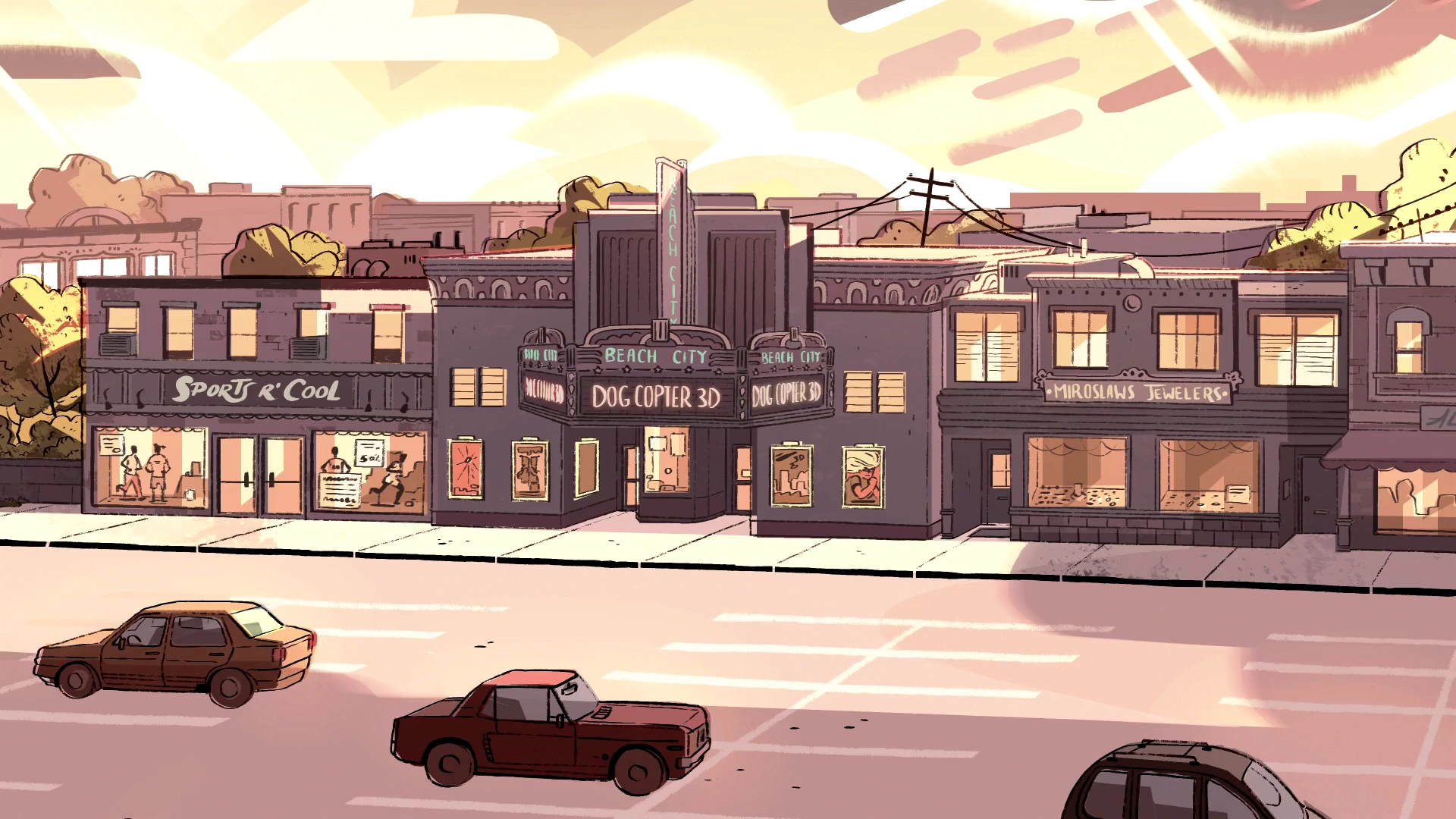
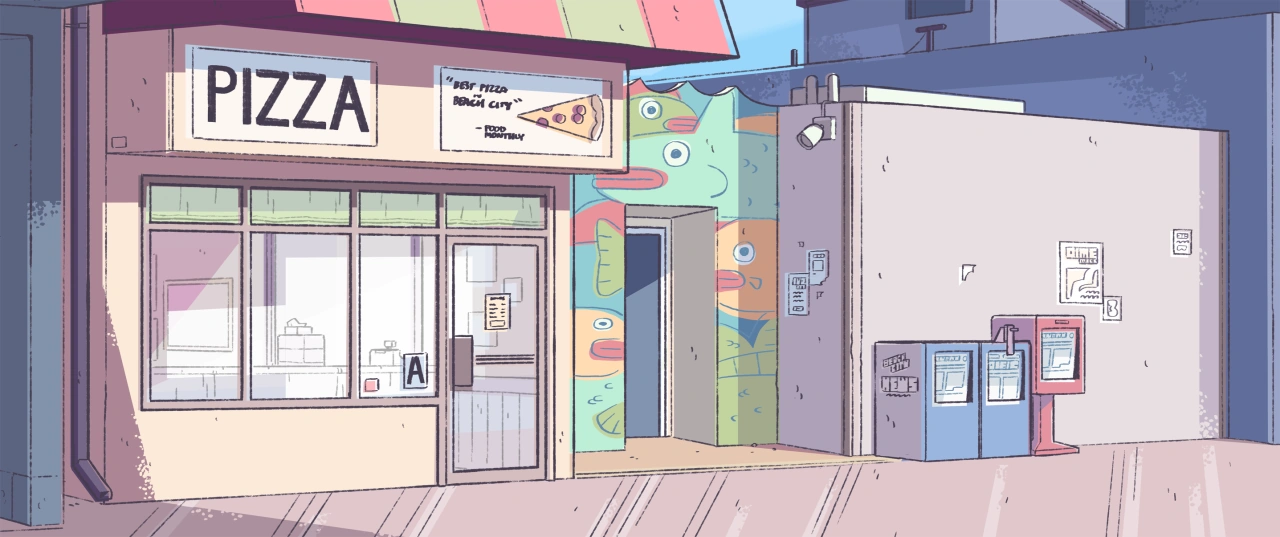
For the design of the backgrounds, I wanted the setting to be the average London street with corner shops and walls with graffiti. To design the backgrounds, I took inspiration from pictures that I took during walks in places such as Clapham.
Photos that I took on the street in Clapham that were used for inspiration.
For the art style of the backgrounds, I took inspiration from the background designs of the show Steven Universe, especially with the style of sketchy line art and lighting.
When drawing the backgrounds, I initially planned for every scene to be set during the day time so I drew every background as being set around the afternoon.
Background drawings I had drawn
However, I received feedback that the scenes where the animation switches between when the main character is being interviewed in the present and when it is a flashback to when she stopped the robber were hard to differentiate and could be confusing. Because of that, I tried different methods to differentiate the scenes, such as potentially making the flashback scenes be in black and white or being coloured with a different lighting before I settled on making the flashbacks set during the daytime and the main character talking set during night time.
The backgrounds for the scenes where the main character is talking in the present being set in night time
While colouring the backgrounds, I also did several tests with the character in the environments to see if they fit in well with the setting or if they contrasted enough or not, as well as to see how the lighting would be on the characters.
Background tests of the first flashback scene in black and white and in normal lighting (Top left and top right image). Background tests of the last scene when the character is talking set at day time and set at night (Bottom left and bottom right).Background tests of the main character talking in the present set at daytime and set at night time
Other changes I made to the backgrounds following feedback were blurring parts of the background so that they don’t take away focus from the main character.
Character designs
Main character – Kaya
For the main character that is being interviewed, named Kaya, I wanted to go for the design of my character was that of a fashionable teenager or young adult with an expressive and sarcastic personality.
As the person I interviewed for my audio was Southeast Asian, I wanted to design a character that was of Asian descent. Thus, I looked to taking inspiration from the designs of characters of Asian descent, particularly Jentry Chau from the series Jentry Chau vs The Underworld, and the character Rinna from the series Win or Lose. I also took further inspiration from actor Greta Lee as an initial reference for designing the character’s face. While designing the main character’s clothes I sought to give her a streetwear inspired aesthetic, particularly with baggy jeans and wide shirts or sports jerseys go give her a casual look.
The mood board I created for the design inspiration of the main characterSketches I did for Kaya’s designThe initial designs of the Kaya and expression sheet and mouth sheet.
For the initial design of the character, I originally had a more detailed design with elements such as a star and stripes on her shirt and details of pockets on her jeans. However, I was advised that these elements would make the character too detailed during animating her so I was advised to simplify the design further.
Final character turnaround for Kaya
Robber
For the design of the robber, I had in mind from the beginning of depicting the robber in a stereotypical robber for comedic effect. When designing his character, I sought to find ways that incorporated elements of his design in interesting ways, such as having his mask and hat merge together and have the line of his cap function as his eyebrows. When designing his body, I wanted to depict him as a sneaky robber so I designed him with a lanky body. I feel that his design was quite successful in having an expressive character that communicates the robber’s personality to the audience. I also feel that his design is a good contrast to the police officer’s design as his lanky design contrasting with the police officer’s stockier proportions would help to depict the difference of power between the two.
The stereotypical image of a robber and actor Jonathan Fairbanks were used as references/visual inspiration for the robberSketches of the robber I didCharacter turnaround and expression sheet I did for the robber
Policeman
Designing the policeman, I focused on making his design accurate to the uniforms of what London policeman wear to make both the character and the setting recognisable as being London. While designing the character, I used actor Omar Epps as a reference when drawing his face and facial expressions. When designing his body, I looked at examples on how to exaggerate his body proportions to give an air of authority or power to him, using character designs from Teenage Mutant Ninja Turtles Mutant Mayhem as reference due to their characters having exaggerated proportions. Thus, while designing the cop, I focused on having him have a wide and stocky torso to give him an imposing figure, and I gave his head angular features to make it more expressive and have a more interesting shape.
Mood board for the inspiration for the policeman’s designSketches of the policeman I didCharacter turnaround and expression sheet for the policeman
X Sheets
X sheets done for the mouth movements in the animation
In this exercise, we were tasked to write our thoughts freely without any planning or any revision and to see what naturally comes out.
For this first practice, I ended up writing about how I perceive the world as an artist, particularly with how I analyse things in my surroundings such as locations and people to find inspiration for my work. Following this, we were told to pick certain words that stood out in our writing and write another entry focusing on those words.
Two words I had chosen were ‘react’ and ‘interact’ which were originally written in regards to how I notice the way people’s personalities interact with each other as part of my observations of the world around me. I chose these words to write deeper into as I feel there is a lot to go into in regards to how I believe relationships are formed as a result of two different personalities reacting to each other.
Media Landscape
For this exercise, we were tasked to take and combine images from magazine scraps and form them into a story together. The instructions were to use metal squares provided to cut out squares out of the images provided. However, I misunderstood the instructions and instead cut out the images not as squares but as their own individual visual elements and ended up creating a collage of my own interpretation of the task. While putting the images together into a narrative, this was the collage of images I created:
I ended up creating a narrative with the theme of ambition and technological progress, as depicted with birds and flight representing a higher goal for humanity to reach and the buildings as the norm/status quo that they are trying to change with the rocket being a symbol of humanity rising above its limitations to reach its ambitions. The following is a journal entry I wrote on the themes I depicted in my collage:
Into the Woods
For this exercise we were tasked to wander in a library and find interesting books that seemed obscure or had been long discontinued. By finding books that were dated or had not been read much/had not been read for a long time, we were to find sources of inspiration from more unique perspectives and understand how ideas changed over time.
Book 1:Advertising and British Art by Walter Shaw Sparrow
I initially chose this book as the look of its worn-out spine stood out to me among the rest of the graphic design books it was placed with. I thought this book would have been interesting to analyse as being a historical book on graphic art would provide an interesting look into what art used to be contemporary and how design trends have changed since then.
Below are my notes on my observations and thoughts about the book as I skimmed through it.
Book 2: Beauty in History by Arthur Marwick
This was the second book I chose to analyse as I felt that a book covering beauty trends throughout history would provide interesting information on how societal and cultural values change over time.
Below are my notes on my observations and thoughts about the book as I skimmed through it.
Book 3: Form magazines
I chose to analyse this series of magazines next as they caught my eye from the bookshelf, particularly with how several of the issues were compiled as loose pages in a folder instead of as individual issues, having long deteriorated from their original state. Upon further digging, I came across a whole collection of the magazines which ranged from the 1940s to the early 2000s. Analysing this magazine series provided me a chance to compare and contrast how the visuals had changed from the earlier publications to the more modern ones with the influence of new technology and design trends. It further provided a look into how cultural and societal norms that the magazine covered had stayed the same or changed throughout the magazine’s lifetime.
Below are my notes on my observations and thoughts about the book as I skimmed through it.
Pseudonym
For this exercise, were tasked with creating a film review for a fictional film by a fictional film director. For the fictional film, I chose to use the plot of an actual story that I am working on for a personal project about two siblings who start a revolution to overthrow a military dictatorship on a fictional island in Southeast Asia. Thus, I was able to use this exercise to provide a critique for myself for what are the possible strengths and flaws my own story writing could have. For the fictional director, I came up with the name of Nguyen Van Khanh to have a director that would be of Southeast Asian descent such as myself and would have used his experience and knowledge of dictatorships and the struggle for democracy in Southeast Asian countries to provide the inspiration for his story.
In our first week of our Monochrome elective, we first began learning and experimenting with patterned animation. We started with tracing charcoal on paper over an electrical sockets to create black and white patterns that we then created a stop motion animation with.
This was the first of several patterned animations we would make as we would then be tasked to observe our environments to find more repeating patterns we could film. First we filmed patterns we could find inside the LCC campus building.
Following this, we were then tasked to film something that was “boring” or “ugly” which I responded with by filming rubbish bins on the street in my neighbourhood.
From these initial tests we were able to gain an initial understanding of the experimental mindset we were going to have while creating our films. From this we were able to understand how find different sources of inspiration where we wouldn’t normally look for it for our work.